Saturday, August 08, 2020

Maybe The Almighty Has Spoken To Oli

He’s not letting this one go.
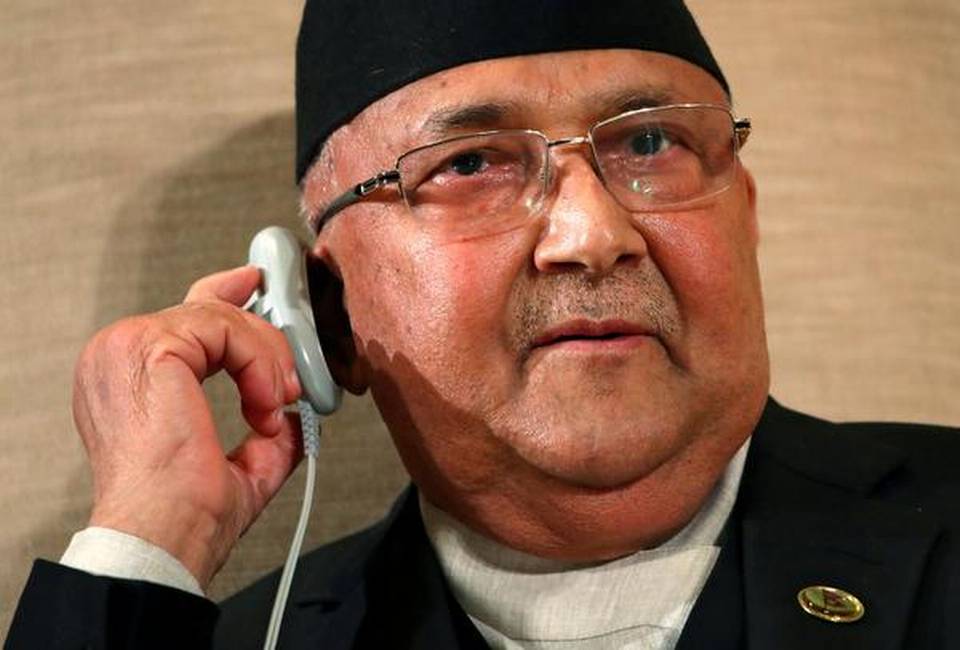
Weeks after insisting that Lord Ram was born in Nepal, and not India, Prime Minister K.P. Sharma Oli has now directed the elected leaders of Madi municipality to build a Ram temple there.
During a meeting with those leaders, Oli said the government would change the name of Madi municipality to Ayodhyapuri. He also instructed them to prepare a grand fair on Ram Navami, the deity’s birthday.
The obvious question here is as clichéd as it is relevant. What has prompted our officially atheist premier to espouse such a profoundly religious cause and at such political risk? Oli’s July 13 accusation of Indian cultural encroachment vis-à-vis the birthplace of Lord Ram came close on the heels of his effort to remedy India’s cartographic aggression through a constitutional amendment enshrining Nepal’s new territorial map.
No amount of rage or ridicule from India and within Nepal seems to have deterred Oli. One reason may be the resoluteness with which Nepali scholars have been making the same assertion for so long. The prime minister’s comments during Bhanu Jayanti observances last month unleashed a torrent of analyses, interviews and commentaries that provided even the most diehard skeptics room to pause.
But, then, Oli could easily have left the issue to play out in public. In ramping up the rhetoric, is he somehow demonstrating an intention to extract the most from the prevailing momentum? After all, only days ago Indian Prime Minister Narendra Modi laid the foundation for the Ram temple in Ayodhya in a culmination of a decades-long battle.
Could Oli be thinking of a tradeoff of sorts between Ram’s precise birthplace and Nepali territories India currently controls? You’d think any prime minister willing to barter God in such a way was out of his mind. But, then, Oli heads a party that has officially renounced religion. Who says he sees no use of God? If religion could help him bring back lost territories, wouldn’t he risk deploying it politically?
Admittedly, there is that imperative of tying India down tightly enough to prevent it from flashing the Tibet card as an aging Dalai Lama portends a bitter succession struggle. Oli knows he needs to camouflage any such maneuver with a national narrative.
Could Oli be playing a shrewd game here? An India exhausted by Nepali antics on multiple fronts might be amenable to returning those lands and redefining the bilateral relationship on a more equal footing. Even if there is the slightest chance of that happening, Oli does have the temptation and temperament to pursue it.
If, on the other hand, Oli is resigned to a full display of Indian displeasure at its erosion of influence in South Asia and Nepal’s particular vulnerabilities therein, why not make the most of the situation? By drawing in the Chinese closer to save his government, Oli might even be hastening a Sino-Indian condominium for the next stage of our political evolution.
Should a political ‘accident’ occur here, Oli could evade blame for the entire post-2006 political establishment. Has God spoken to him?

Saturday, August 01, 2020

Haughty And Hollow ‘Homecoming’

When Sunil Thapa broke away from the recently (re)unified Rastriya Prajatantra Party (RPP) with dozens of supporters and joined the Nepali Congress, the ensuing sense of relief seemed more palpable on the side of the royalist party.
Thapa himself hasn’t given a compelling reason for switching parties. His contention that the RPP, committed to the restoration of constitutional monarchy and Hindu statehood, was working against the popular mandate may be theoretically sound enough. Yet it is an insufficient explanation, given how politics is playing out. Even if we concede that republicanism and secularism (and its third cousin, federalism) were ever set in stone as a precondition to a new Nepal, public opinion has shifted sufficiently lately to undercut Thapa’s argument.
Thapa has also said he decided to join the Nepali Congress to confront the communist juggernaut. The entry of another republican into the party at a time when more and more Nepali Congress loyalists are counting the cost of their decision to dissociate from constitutional monarchy makes little sense.
Such realities, however, have not stopped both sides from bouncy back-slapping. Thapa said he felt a sense of homecoming in that his late father, former prime minister Surya Bahadur Thapa and founder of the RPP, was once a Nepali Congress functionary.
NC general secretary Shashank Koirala, too, was effusive in his praise. His late father, B.P. Koirala, Nepal’s first elected prime minister, would have wholeheartedly welcomed Surya Bahadur Thapa had he renounced the Panchayat system and joined the Nepali Congress, Shashank gushed.
Really? Discerning students of Nepali politics would be required to suspend disbelief here. When King Mahendra freed B.P. from prison in 1968, eight years after dismissing Nepal’s first elected government and abolishing multiparty democracy, a reconciliation process was under way between the two titans.
Prime Minister Surya Bahadur Thapa, in collaboration with Indian Ambassador Raj Bahadur, moved swiftly to scuttle things. How well the elder Thapa succeeded has been put on the public record by B.P. and his intermediary and younger brother, Girija Prasad Koirala. Thapa contrived the fiction that King Mahendra actually intended to harm B.P. and relentlessly peddled it to the point where the Nepali Congress leader was spooked enough to exile himself in India and raise arms against the royal regime.
After that, Thapa’s political fortunes, too, plummeted. Shortly after King Birendra ascended to the throne in 1972, Thapa began campaigning against what he denounced as the ‘dyarchy’ of Narayanhity Palace and Singha Durbar. When the royal government threw him behind bars, Thapa went on a hunger strike that failed to intimidate the new king.
Finding himself in the political wilderness, Thapa once again turned to B.P., who had returned home from exile on a platform of national reconciliation. During the monarch’s extended tour of the eastern region, Thapa issued a statement demanding the death penalty for B.P. for treason. Instead, the palace permitted B.P. to travel to the United States for medical treatment.
Back as prime minister to oversee the 1980 referendum, in which a ‘reformed’ Panchayat won by a comfortable majority, Thapa continued to head the government. King Birendra had made a public pledge to respect the views of the minority, i.e., the multiparty camp.
B.P., the lone voice in the opposition who accepted what he called an ‘inexplicable’ but democratic verdict, sought a basic concession that would allow the Nepali Congress to contest the elections. Could the Panchayat bosses strike down the requirement that candidates should belong to one of the six class organizations? Thapa, mindful of the challenge this would pose to his politics, led the anti-B.P. charge here, too.
Even after all this, maybe B.P. would have exhibited his characteristic magnanimity and welcomed Surya Bahadur Thapa into the Nepali Congress. Still, it would be a stretch – if not outright slanderous – for Sunil Thapa to claim that his joining the party was akin to a homecoming.

Sunday, July 26, 2020

All Together Now

Narayan Kaji Shrestha, the spokesperson of the ruling Nepal Communist Party (NCP), wonders why state institutions are making decisions that seem to undermine our political system?
That’s a fair question. The Supreme Court frees a former deputy inspector general of police sentenced to life imprisonment for murdering his wife. The President invites a group of journalists, opens up and bids them goodbye telling them everything she said was off the record.
The prime minister’s loquacious legerdemain has been exacerbating our inability to focus on the issue of the moment. Legislative sessions have ceased to evoke public interest beyond who’s snoozing, yawning and gaping there.
The ruling party doesn’t know how long it can maintain the fiction of unity and is worried about running out of excuses. The main opposition party expels longstanding leaders on the flimsiest of allegations but is eager to welcome people breaking away from all kinds of other parties.
Having exhausted every political experiment, the people are understandably downhearted. It’s not that we have run out of alternatives to the status quo. No single one commands enough support to bring people onto the streets. For the first time since Matrika Prasad Koirala held that official title in 1950-1951, ‘dictator’ is beginning to acquire some positive connotation in the popular imagination.
The post-2006 political leadership, to be sure, has benefited from this apathy and could continue doing so. But it seems to have lost patience. The inevitability of collapse makes the wait more excruciating.
From the outset, the notion of a ‘new’ Nepal was too nebulous to work. Since it was a collective enterprise pushed by dominant internal political players carefully anointed by geopolitically attuned external stakeholders, the quest could carry particular momentum.
The script, moreover, could change with such great convenience because arbitrariness was camouflaged as compromise. A decade down the line, the new constitution stood on the three pillars that were not part of the agenda of ‘People’s Movement II’.
If anything, the outcome has been dear and dreadful. New taxes have been levied to fund and facilitate additional layers of the federalism-driven political/administrative machinery, with little to show for the people. Secularism is being promoted as affirmative action for a religion that has been the farthest from our roots. Republicanism has spawned neo-royalism with a pomp and splendor beating the ancien regime.
In retrospect, the political class made a shrewd bet. Since the Nepali people went along with each compromise made to uphold the main – albeit tenuous – 12-point compact, they, too, became stakeholders. Ordinarily, corruption may be a bad word, but in context, its institutionalization is what lubricates the state machinery in a resource-strapped economy. Nepotism, too, is part of the manifestation of newness with Nepali characteristics. After all, preserving hard-won gains requires us to make hard choices.
But, alas, the world around us has a logic of its own. When they made investments, each external stakeholder was benign in its intention. When the time has come to claim their return, they have turned bold in their expectations.
The political class is anxious to hasten what is considers an inescapable breakdown. Since no one is prepared to take the fall individually, they seem intent on collective responsibility.

Saturday, July 18, 2020

Every Which Way, Comrades (Up) In Arms

Prime Minister K.P. Sharma Oli’s inducement of an early unity convention seems to have appeased his Nepal Communist Party (NCP) Pushpa Kamal Dahal ‘Prachanda’ enough to start talking.
Although the NCP Secretariat, abruptly convened amid the technically ongoing but repeatedly delayed Standing Committee, failed to break the ice, the principal disputants seem to be working on a compromise that would ‘prepone’ the NCP convention from 2021 to later this year.
Reports of a fresh pact – clearly witnessed, if not actually brokered, by President Bidya Bhandari – have naturally alarmed the other members of the Dahal-led alliance, including former prime ministers Madhav Nepal and Jhal Nath Khanal. But those two men have already subordinated themselves to Dahal sufficiently for the ex-Maoist supremo to comfortably grasp a deal that is good enough for him.
As we all know by heart, the ruling NCP was formally set up in February 2018 with the merger of the major Unified Marxist-Leninist and Maoist factions after their alliance won overwhelming popular support in elections the previous year. Real consolidation of the two groups has not even begun. For whatever reason, the two co-chairs left crucial decisions to the convention, allowing them to drive the agenda interim.
Dahal has vacillated on the validity and relevance of the arrangement in which the two men would take turns as prime minister during the party’s five-year term in power. It has since emerged that Dahal knew all along that nothing he asked for – good, bad or ugly – could be achieved without Oli signing off. So no more prizes for uncovering the origins of Oli’s obstinacy.
Still, nothing is set in stone, much less when it’s the NCP we are talking about. While Oli’s health remains a major imponderable, Dahal’s potential legal problems are no less formidable. Oli opponents could still go through the motions and seek newer avenues to demand that he step down from the premiership and/or the NCP leadership, depending on the mood of the moment. Oli could continue dangling the sword of a party split, mid-term elections and even systemic collapse to stay in power. Disregard the surface currents and dive deeper.
Long rumored to have been behind the Oli-Dahal unification, the Chinese are doing their best to establish the veracity of such reports. They have been holding regular training sessions for NCP members with the ardor of a principal stakeholder. Chinese Ambassador Hou Yanqi has stepped up consultations with rival NCP leaders amid growing criticism and calumny, mindful perhaps that it is more so in India than in Nepal. Still, Beijing remains undaunted in publicly abandoning its much-vaunted policy of non-interference in the internal affairs of other countries.
The intriguing question of why China would want to save the premiership of the most pro-Millennium Challenge Corporation (albeit not the most pro-American) leader in the ruling party has ceased to confound too many of us. A CPN split between pro-Indian and pro-Chinese factions may not give Beijing too much room for maneuver. Yet Beijing understands that a formally – even if only theoretically – united ruling party would help to lower the risk of mischief by other external forces.
The contradictions inherent in any common India-US approach to China globally are too stark to make a significant impact in Nepal immediately. Perhaps the shenanigans in the NCP, the loose cannon called Oli, Dahal’s atypical bashfulness, and the hourly fluctuations in the focus of our political discourse carry more considerable significance than we choose to confer.

Saturday, July 11, 2020

Cooking Up A More Credible Casus Belli?

Nature’s fury seems to have coerced the ruling Nepal Communist Party (NCP) into putting off its rambunctious standing committee meeting for a week.
Has a party on the verge of a damaging split somehow stepped back from the brink? More likely, it has been shamed into postponing the inevitable.
Prime Minister Khadga Prasad Sharma Oli and his NCP rival and co-chair Pushpa Kamal Dahal ‘Prachanda’ had dug in their heels so deep that their one-on-one meetings had started becoming a curious affair. Since the two men had nothing new to say, they began shouting at each other what they’ve always been saying.
The rival NCP camps were getting apprehensive as Chinese Ambassador Hou Yanqi resumed her consultations to keep the party intact. The Indians, already miffed by Her Excellency’s earlier success in rescuing Oli, began taking cheap shots in all directions.
For months now, Indian analysts and experts have been trying hard to make a distinction between the Nepali people and their incumbent prime minister. Sleazy and sloppy Indian media reports have subverted that ploy. Even the loudest domestic critics of Oli hated the way the Indians were trying to undermine our elected prime minister. Oli supporters kept rallying in public, rain and/or Covid-19.
Things got so disgraceful on the China-versus-India front that one Indian reporter eventually revealed that the chiefs of India’s domestic and external intelligence agencies were camped in Kathmandu for political parleys far broader than Chinese ambassador’s. Two detectives versus one diplomat might sound unfair. But, then, who knows what the other ‘external stakeholders’ are up to.
It took an act of God to afford the officially atheist NCP some relief. Oli went on television to say that the crisis in the NCP was too internal to affect his government’s performance. Dahal, back at his home constituency in Chitwan, wondered what he might have wrought had he become a bit too rash in Kathmandu.
So, what’s the hiatus really about? Oli and Dahal (and the rest) have been shamed into pulling back, apparently by second-generation NCP leaders. A compromise formula is said to be in the works that would allow Oli to keep the top government and party posts. In exchange, Oli is being persuaded to hand over greater day-to-day control of the NCP to Dahal.
If things go according to plan, the prime minister may start awarding key chief ministerships to Madhav Nepal loyalists and run the government in closer consultation with other leaders. A cabinet reshuffle incorporating more rival faction members, and greater representation of the Dahal and Nepal camps in diplomatic and political appointments could be part of the new compromise.
But, then, what’s new here? Such commitments were made many times in the past. Oli rivals took little time in accusing the prime minister of reneging on them. Can the prospect of ignominy alone separate the belligerents? Not likely.
Even though we may have dodged the bullet, for now, it’s pretty clear the principal protagonists are already regrouping for another day. Bereft of ideological coherence from inception, the NCP is too consumed by factions and personal ambitions to continue as a single organization. The principal satraps want a decisive battle so bad that they may just be looking for a casus belli that is credible enough.