Saturday, July 29, 2006

The Other Summit And The October Option

The delay in the second round of formal talks between Prime Minister Girija Prasad Koirala and Maoist chairman Prachanda may have cast some uncertainty over the peace process, but it certainly hasn’t stopped the rebel chief from holding another vital summit.
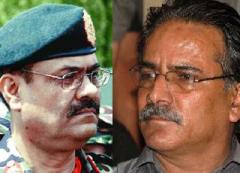
Casting aside protocol, the supreme commander in chief of the People’s Liberation Army held talks with Nepal Army chief Gen. Pyar Jung Thapa. Had the House of Representatives heeded former premier Sher Bahadur Deuba and allowed King Gyanendra to retain the supreme C-in-C job without the uniform, Prachanda might have finally ventured into Narayanhity Royal Palace. (On second thoughts, maybe he already has and will tell us about it in due course.)
News of the soldier-to-soldier summit came from Prachanda himself. At a public program in the capital, the Maoist supremo said he had met the NA chief for consultations on managing weapons. Gen. Thapa, according to Prachanda, said he would follow any modalities laid down by Prime Minister Koirala.
This prompted Prachanda to thank Gen. Thapa for his faith in the prime minister. (The comrade in chief finally seems to have discovered who holds the actual reins of power.)
Prime Minister Koirala’s own telephone conversation with Prachanda around this time was no less revealing. Koirala, we understand, told Prachanda that he should seize the opportunity for peace while he (Koirala) is still alive. With no presumed successor to the ailing Koirala in sight within his Nepali Congress, the situation is bad enough. We don’t know whether the Nepali Congress would even get the premiership should Koirala, God forbid, depart.
Prachanda, for his part, is taking his own time. Having emerged from decades in the shadows, he deserves all the sunshine he can bask in – and on both sides. Days after rejecting the government’s letter to United Nations with own missive to Kofi Annan, Prachanda still professes good faith. He has begun consultations with a UN mission headed by Staffan de Mistura to “forge a common understanding.”
The rebel chief has extended the ceasefire for another three months, but not without a stern warning. “We want to follow the pact we signed with the seven-party ruling alliance and take peace talks forward,” he said. “But if that fails, we would be compelled to begin another intense though peaceful people's movement.”
Consider the Maoists’ plight: Everyone barring the Chinese has explicitly called for the rebels’ disarmament before the formation of an interim government. Even the Indians who “forged” the SPA-Maoist alliance don’t want to see armed Maoists in power.
The Maoists aren’t talking about an armed political party like Hezbollah. They are talking about a well-regulated people’s militia, something along the lines of what the Second Amendment to the US Constitution envisages. (Maybe Prachanda should reach out to the National Rifle Association for some PR help.)
And the Americans? Didn’t they once recognize a coalition government in exile an armed Khmer Rouge was part of when the Vietnamese were running the show back home?
Linger a little longer with the Chaudharis and the Khetans and it might be too late to go back to the jungles. Surely, Ganapathy and his band of Naxals must be seething at this betrayal of the revolution.
But maybe Prachanda is really biding his time. Without Koirala, the SPA would just implode. The Maoist truce is set to expire in the last week of October, right? So Prachanda can still make good on his threat to launch that much-vaunted revolution.

Wednesday, July 26, 2006

The Lady Is A Trampler

As Prime Minister Girija Prasad Koirala’s Nepal Sarkar and Prachanda’s Jana Sarkar take their battle all the way to United Nations Secretary-General Kofi Annan, a third “government” has stepped into the realm of our Fourth Estate.
This officialdom is actually an individual. A Kathmandu-based correspondent for an Indian news service with wider Asian pretensions, she has been using her status as the representative for multiple media outlets down south to create and spread “news”.
The lady’s beat of choice continues to be Narayanhity Royal Palace. Anyone with anything that denigrates the king, crown prince and royalty as such can expect a sympathetic hearing. If the story line fits her “agenda,” she will package the product in a way that gets by-lined coverage in the top dailies of West Bengal (her home state?) and Andhra Pradesh as well.
Sprinkle in a few gender-specific facts (and fiction), and you can expect the world’s women to regale in her feature-writing skills. With a little geopolitical twist here and there, her prose even ends up commanding attention among thinkers in Geneva.
In recent dispatches, though, our lady has started telling more about herself – of course not in so many words. Actually, you have to read between lines. Take her latest story on King Gyanendra’s increasing fondness for late-night Internet gambling.
Our lady picked the story straight from her favorite Nepali tabloid published on Wednesdays. Yes, the same tabloid she quoted in her recent copy detailing the monarch’s bout with depression. (Full disclosure: Sensational and spicy, the weekly is one of Maila Baje’s first reads of the day. In the symbiotic relationship between the lady and the tabloid, it is sometimes difficult to discover who is feeding information to whom.)
In its version, the weekly carefully noted that the information emerged during the conference of Indian ambassadors to South Asian nations chaired by Indian Foreign Secretary Shyam Saran at the Hyatt Regency Hotel.
The tabloid quoted Shiv Shankar Menon – India’s top diplomat in Pakistan and Saran’s presumptive successor at the Ministry of External Affairs -- as having made the revelation. The weekly suggested that Indian Embassy moles in the palace may have recorded that tidbit.
In her version, our lady of the immaculate deception conveyed the impression that the tabloid had carried an enterprise story complete with fully sourced details on the royal credit cards. There wasn’t the slightest hint of a tabloid tittle-tattle.
The tabloid and the lady have emerged as one of the most prominent members of Kathmandu’s Mutual Admiration Society. But even the most intimate of relationships have their share of rules and roles, kaso sarkar?

Sunday, July 23, 2006

The Bipolarity That Really Matters

Considering the fervor with which it is broached, speculation of recent secret talks between a team of Chinese officials and top Nepalese Maoist leaders threatens to throw our nascent peace process off course.
According to sections of the Nepalese and Indian media, the Chinese delegates weren’t content with their face-to-face encounter with the Prachanda-Baburam-Mahara triumvirate in the resort of Dhulikhel. They wanted to see the men and women in uniform.
A Maoist maneuver close by provided the perfect setting for this fact-finding tour. Depending on who you listen to, the Maoists have either received firm pledges of Chinese military support or are actually hoarding guns and bullets as we speak.
At first, all this seemed merely to suggest that Nepali Congress leader Govinda Raj Joshi’s had discovered a platform from which he could resurrect his blemished politics. Painting the northern neighbor as the principal obstacle to peace is a sure-shot way of ensuring the eternal patronage of those who matter down south.
Since the story has acquired a momentum of its own, it no longer matters whether a Chinese-Maoist alliance is merely a perception or a reality. So the subject must be approached with the seriousness it warrants.
At a time when Nepal is grappling with what to do with the weapons the Maoists already have, why has China stepped in with an offer of more? Bring up all the pejoratives you want, but you can’t accuse the Chinese of being interventionist on the side of war before listing a bunch of other friends and neighbors of Nepal.
Perhaps the two have been united more by compulsion than choice. Contrary to popular belief, the April Uprising was not a success for the Maoists. Everyone knows that the rebels were at the forefront of the anti-palace protests. Everyone also knows that the Seven Party Alliance (SPA) leaders went AWOL as the protests climaxed. And the first thing they did even before fully emerging to relish victory is reject the slightest suggestion of a Maoist role in the protests.
Initially, the comrades seemed to empathize with the embarrassment the SPA leadership would have suffered had it acknowledged the rebels’ preeminence in bringing down the royal regime. However, suspicions deepened as each constituent started repeating that negation. Maoist supremo Prachanda had to reprimand the SPA for what he called a sustained campaign to marginalize the rebels before the government would even contemplate a summit. Prachanda’s ferocity at his first news conference was rooted either in wounded pride to the promise of power. Then the SPA signatories to the eight-point accord began describing their assent as a mistake.
With Prime Minister Girija Prasad Koirala in poor health and the two deputy premiers locked in a bitter power struggle, Prachanda unleashed his October Revolution threat. That pushed the Unified Marxist Leninists closer toward the state army they had just emasculated.
Worse, Washington and New Delhi, in a remarkable coincidence of timing, rejected the notion of the Maoists joining an interim government without disarming. The copy of the letter the government wrote to Kofi Annan seeking U.N. involvement in managing rebel arms got lost even before the foreign minister got a chance to read it.
By then Prachanda & Co realized that the spirit – if not the letter -- of last November’s 12-point SPA-Maoist accord did not envisage a significant political role for the rebels in a post-royal-regime arrangement. Suddenly, the Maoists’ political leadership figured out the threat levels emanating from their own fighters as well as their Indian allies.
Running for cover, they discovered how bruised the Chinese were after the fall of the royal regime. Indian reporters based in Kathmandu made much of how the royal defeat was an unmitigated debacle for Beijing. Nepalese Maoists pursued a different line of inquiry.
The Chinese, our comrades concluded, must have based their acquiescence in the India-driven evisceration of the monarchy on their mutual interest in marginalizing the Americans. And what does the SPA government do? It allows the reopening of the Tibetan offices shut down by the royal regime and works toward providing Tibetan refugees travel documents for resettlement in the United States.
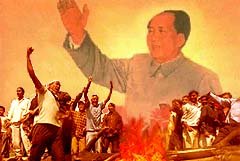
Compulsion clarified compatibilities. For the Maoists, the Chinese communists may be guilty of ideological deviance. But they never branded the Nepalese rebels terrorists. From the Chinese point of view, the Maoists as warriors tarnished the reputation of the founder of the People’s Republic. As men and women of peace, the Nepalese rebels not only represent dispossessed and marginalized but also 70 percent of what Beijing officially considers to be Maoism’s enduring magnificence.
Nepalis remain precariously perched between the vigilance of their two giant neighbors. That’s the bipolarity that really matters.

Tuesday, July 18, 2006

Sitaula: Between Prachanda And Ganapathy?

Canceling a scheduled meeting with a European Parliament delegation, Home Minister Krishna Prasad Sitaula left for India on Monday on a three-day ‘religious’ visit. Finance Minister Dr. Ram Sharan Mahat has been designated by Prime Minister Girija Prasad Koirala to look after the Home Ministry during Sitaula's absence.
Sources close to Sitaula said he was heading for the Indian state of Jharkhand to pay homage to a saint named “Thakur Baba”. A pretty odd time for the Maoists’ chief confidant in power to be leaving the country. On the other hand, Nepal does need all the advice – political, spiritual and extraterrestrial – it can get at this critical juncture.
Maila Baje couldn’t help delving a little deeper into the matter. Sitaula, under fire from his own Nepali Congress for granting a string of concessions to the Maoists, is suspected of having inserted the clause on dissolving the House of Representative without the prime minister’s knowledge in the eight-point accord.
With that row now imperilling the peace process, could Sitaula have gone for consultations with the principal architects of last November’s Seven Party Alliance-Maoist accord?
For a politician who barely tries to conceal his admiration for every bit of official advice emanating from across the southern border, flying into New Delhi would have not been prudent. Could the ordinariness of Jharkhand have been intended to obscure the substance of Sitaula’s consultations? Whisking him away to New Delhi from Jharkhand wouldn’t be that difficult, either.
Or could the pilgrimage merely be a cover for the shifting dynamics in the peace process. The principal government interlocutor, demonized by his own party, seeks solace in the company of a seer.
The minister who steps in is known for his closeness to foreign stakeholders farther afield. (Would Crown Prince Paras’ game of golf with American Ambassador James F. Moriarty have merited so much column space in The Washington Post several months ago if Sitaula had been the Nepali Congress politician grumbling?) Watch out for the next statement from each side on the imminence or otherwise of a Maoist-inclusive interim government.
Maybe Sitaula is away in Jharkhand for serious political discussions on the peace process – with leaders of the Communist Party of India (Maoists). Remember Ganapathy, Prachanda’s Indian counterpart? Yeah, the guy with whom Prachanda issued a statement reiterating their “pledge to fight unitedly till the entire conspiracies hatched by the imperialists and reactionaries are crushed and the people’s cause of socialism and communism are established in Nepal, India and all over the world.”
Sitaula may be getting the rap at home for capitulating to Prachanda. From Ganapathy’s perspective, Prachanda is culprit. Each step the Nepalese rebels take toward the mainstream represents a betrayal of the revolution India’s Naxals envisage.
Remember Prachanda’s rosy rhetoric on creating that South Asian Compact Revolutionary Zone? His Indian allies are working hard on carving out their component of the structure, only to see the Nepalese rebels repudiate it for the sake of imminent political power.
No wonder Prachanda, Dr. Baburam Bhattarai and others seem to feel far safer inside Nepal these days, although there is very little that would prevent Ganapathy from ordering cross-border hits. I guess the question really is, did Prachanda ask Sitaula to mediate with Ganapathy?

Monday, July 17, 2006

Trivialization Truth

Less than a 100 day before he was forced to give up direct rule, events have vindicated King Gyanendra’s February 1, 2005 takeover of full executive powers – at least from one standpoint. In his proclamation, the monarch had cited, among other things, the political leadership’s trivialization of national issues during their 1990-2002 stint in power. If anything, the mainstream parties’ propensity for cheapening the national discourse has worsened since their return to power in April.
The other day we were told the Nepali Congress, UML and Maoists had agreed to replace the House of Representatives with an interim arrangement. A breakthrough indeed, considering that the rebels had unleashed their “people’s war” also against parliament. Before you could pause to consider what thoughts the Nepali Congress (Democratic) and smaller constituents of the Seven Party Alliance (SPA) might have on the issue, Prime Minister Girija Prasad Koirala stunned us by voicing surprise at the deal.
Of course, by then, Sushil Koirala and Ram Chandra Poudel, who had represented Koirala’s Nepali Congress at those talks, had already denied such an agreement was reached.
Within the UML, that “agreement” pitted two senior leaders, K.P. Sharma Oli, Koirala’s deputy premier, and Bam Dev Gautam, the principal Maoist confidant, against each other.
Oli, presumably reflecting the sentiments of his boss, would not hear of any deal on dissolving the legislature before it completed its job. Gautam, as a leading participant in the meeting, insisted dissolution was a precondition for peace from the outset. (It’s growing harder these days to believe that Oli and Gautam were allies against UML general secretary Madhav Kumar Nepal during the last party convention in 2003.)
Madhav Nepal, meanwhile, came out with a baffling suggestion: replace the House of Representatives with an interim parliament ostensibly including Maoist representatives. The absurdity becomes apparent once you consider that even in its most restrictive phase, the Panchayat system had a legislature that was at least partly indirectly elected.
The proposal of Narayan Man Bijukkche, the head of the Nepal Workers and Peasants Party, an SPA constituent, for a 51-member advisory assembly makes more political sense in the current circumstances. At least it contains no illusions that members of a legislature that has outlived its normal life could somehow “elect” interim successors.
The Maoists, for their part, are oscillating between wild alternatives on almost every important issue. They still refuse to concede that the Nepalese people might vote for retaining the monarchy, but, in the same breath, vow to uphold any outcome.
Long a proponent of neutral external monitors, Prachanda now wants the Nepalese to resolve the issue of the rebels’ arms, but then he flatly refuses to disarm. Now the rebels want both armies maintaining their independent status. (Any inspiration from Hezbollah, as suggested in this space a few days ago?)
Amid reports of growing Chinese interest in the rebels, even chief rebel ideologue Dr. Baburam Bhattarai can’t seem to figure out one principal ground reality. Is Beijing reaching out to the Nepalese rebels because of any residual ideological affinity or because it wants the Maoists to reconcile with the monarchy. After all, the Great Helmsman himself, we are told, had encouraged Dr Keshar Jung Rayamajhi do so a generation ago.
What is becoming increasingly clear, though, is that the Maoists are gradually recognizing how their gift for ambiguity has come to haunt them.
So what is King Gyanendra doing? Well, he seems busy. He accepted the credentials from, among others, British Ambassador Andrew Hall. (Hall replaces Keith Bloomfield, who was among the inveterate foreign critics of the royal regime. Unconfirmed reports suggest that Bloomfield, in his farewell audience with King Gyanendra after the SPA’s return to power, assured the monarch he could finally sympathize with his distrust of the current crop of politicos.)
If you really want to know what the monarch thinks about current events, you might want to check out his birthday pictures. It’s hard to miss the “don’t-blame-me” aura.